
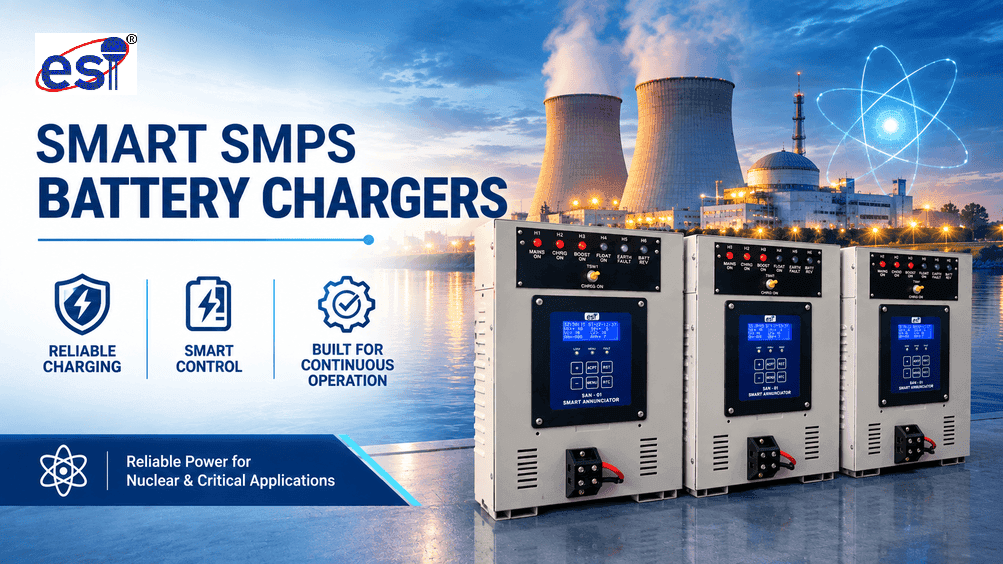
Walk into any substation, telecom tower, or manufacturing plant and you will find a battery bank waiting to take over the moment grid power flickers. What keeps that bank healthy, charged, and ready? In most modern facilities, the answer is an SMPS Battery Charger in India built for local grid conditions. As industries move toward automation, uptime is the baseline, not a luxury. This blog explains why switch-mode technology has become the backbone of reliable industrial backup power.
What Is an SMPS Battery Charger?
SMPS stands for Switch Mode Power Supply. Instead of a bulky transformer working at mains frequency, the charger rectifies incoming AC, converts it into high-frequency pulses, and steps it down to a precisely regulated DC output. The result is a unit that is smaller, lighter, and far more efficient than older designs.
In my experience reviewing power systems at industrial sites, the difference shows up quickly. A well-designed SMPS Battery Charger in India delivers stable voltage and current to lead-acid, VRLA, and Ni-Cd batteries, and increasingly to lithium-ion banks, without the heat and energy waste of legacy units.
Why Traditional Chargers Fall Short
Thyristor and ferro-resonant chargers served industry well for decades, but today’s plants ask for more. They are heavy, run hot, and struggle when input voltage swings. Poor regulation means batteries are either undercharged, which causes sulphation, or overcharged, which dries out cells and shortens life. Since the battery bank is often one of the costliest parts of a backup system, this is a quiet but expensive problem.
Key Benefits of SMPS Technology
- High efficiency: conversion efficiency commonly exceeds 90%, which cuts electricity costs and heat inside panels.
- Tight regulation: output stays stable even when the input varies widely, protecting battery life.
- Compact and lightweight: a smaller footprint frees valuable space in control rooms and cabinets.
- Modular design: hot-swappable rectifier modules with N+1 redundancy mean a single failure never takes the system down.
- Intelligent charging: float, boost, and equalise modes with temperature compensation extend battery life.
- Built-in protection: over-voltage, short-circuit, over-temperature, and reverse-polarity safeguards are standard.
Where Industries Depend on Them
Wherever a DC supply must never fail, a switch-mode charger is at work. Power utilities rely on it for protection relays and breaker trip coils. Refineries, steel plants, and cement factories use it for control and safety systems. Telecom networks, railways, metro projects, data centres, and water treatment plants all depend on continuous DC auxiliary power. Increasingly, project specifications from these sectors call for an SMPS Battery Charger in India because of its reliability, modularity, and low lifecycle cost.
Designed for Indian Grid Conditions
Indian operating conditions are demanding: voltage fluctuations, frequent short outages, dust, humidity, and summer temperatures that push enclosures well past 45°C. A charger that looks impressive on a datasheet can fail on a hot afternoon in Rajasthan or a humid monsoon week in Kolkata.
A dependable SMPS Battery Charger in India should offer:
- A wide input range, such as 160–280 V single-phase or 320–480 V three-phase
- Proper derating at high ambient temperatures
- Conformal-coated PCBs for humidity and dust resistance
- Surge and lightning protection on the input side
These details rarely appear in a brochure headline, but they decide whether a system survives ten years in the field.
How to Choose the Right Charger
Before you finalise a purchase, work through this checklist:
- Match the voltage and current rating to your battery bank’s Ah capacity and expected load.
- Confirm compatibility with your battery chemistry.
- Check the input voltage window against your site’s actual supply quality.
- Look at output ripple and efficiency figures, not just the rated output.
- Ask for remote monitoring options such as Modbus, SNMP, or dry contacts.
- Verify protection features and alarm outputs.
- Review the warranty and service network.
Equally important is who builds the product. Working with an established SMPS Battery Charger manufacturer in India gives you in-house design, proper testing, easier customisation, and faster access to spares and service engineers.
Why Trust and Experience Matter
A battery charger is not a commodity item. It protects equipment and processes worth many times its own price, so credibility matters. Ask for ISO 9001 certification, type test reports, factory acceptance testing, and references from similar installations. A reputable SMPS Battery Charger manufacturer in India will share test data openly, explain design choices, and stand behind the product long after commissioning.
Transparent documentation and responsive after-sales support are the clearest signs of a partner you can rely on. Engineers who have commissioned hundreds of systems will also tell you honestly when a smaller or simpler configuration is enough, which saves you money.
Simple Maintenance Tips
- Even the best equipment benefits from basic care:
- Inspect the charger and battery terminals every quarter.
- Clean dust from vents and filters, especially in cement, mining, and textile environments.
- Check float and boost voltages against the manufacturer’s settings, and verify temperature compensation.
- Test alarms and changeover functions periodically, and keep a log of readings to spot trends early.
These small habits can add years to battery life. A properly maintained SMPS Battery Charger in India often outlasts its warranty by a wide margin.
Conclusion
Modern industrial power systems cannot afford guesswork at the DC level. Switch-mode chargers deliver the efficiency, precision, modularity, and protection that today’s plants demand, while reducing running costs and extending battery life. Whether you are upgrading an old installation or planning a new one, choosing the right SMPS Battery Charger in India is one of the smartest reliability investments you can make.
Ready to power your plant without interruption? Contact our engineering team today for a customised charger solution and a free technical consultation.